
Farmer’s Spotlight
TMU Edition
At the heart of many small markets is a living, evolving food system, one built not only on transactions, but on relationships, knowledge-sharing, and care. Local farmers sit at the center of this system, shaping not only what ends up on our plates, but how land is stewarded, how economies circulate, and how communities connect.
Our partnerships with farmers are grounded in a belief that food systems should be visible and participatory. We want to shorten the distance between farmers and communities, where we can create space for conversations about how food is grown, what it truly costs, its impacts, and why those things matter.
The relationship between a farmer and a market becomes more than a place where we buy food, it becomes a growing, thriving ecosystem of support and care. It’s where seasonality becomes a foodway – where we understand why strawberries are sweeter in the summer, how soil health directly affects nutrient density, and why slower, more deliberate growing practices often give better outcomes for both people and the land.
Our market aims to serve as a bridge, bringing together these stories, practices, and values with the people who rely on them (you, our community).
In this Farmer Spotlight, we’re proud to highlight one of our local partners whose hard work, and passions help keep our market fresh, and our community strong. From long harvest days to conversations at their market, their story is rooted in ecological practice, urban design, and relationship building.
“Going back to ecological practices and being good stewards of growing space.” – Jess Russell
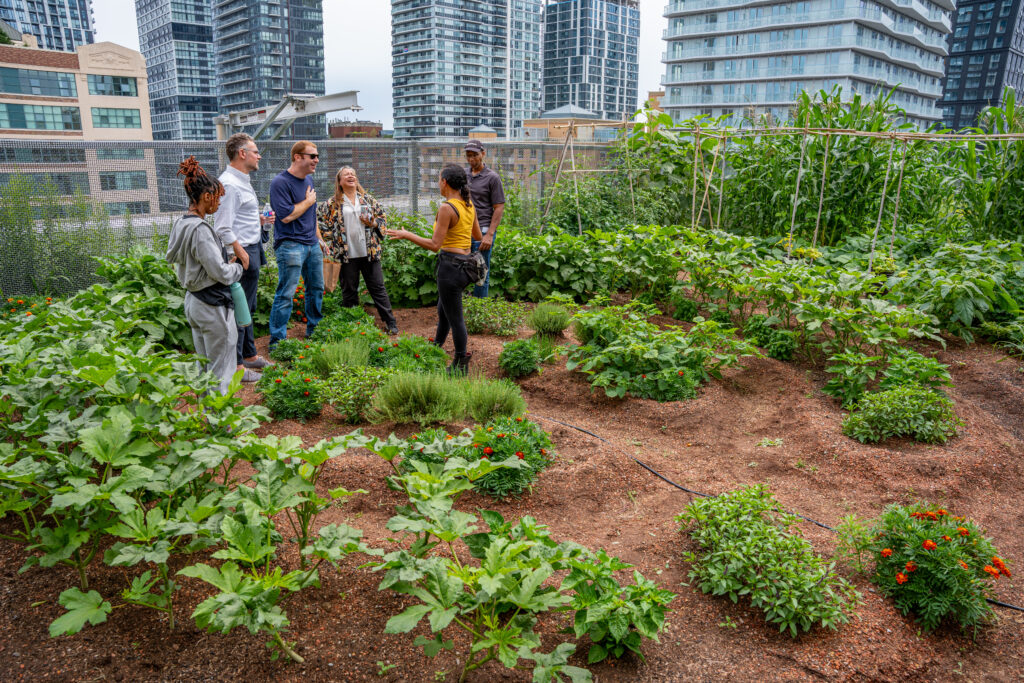
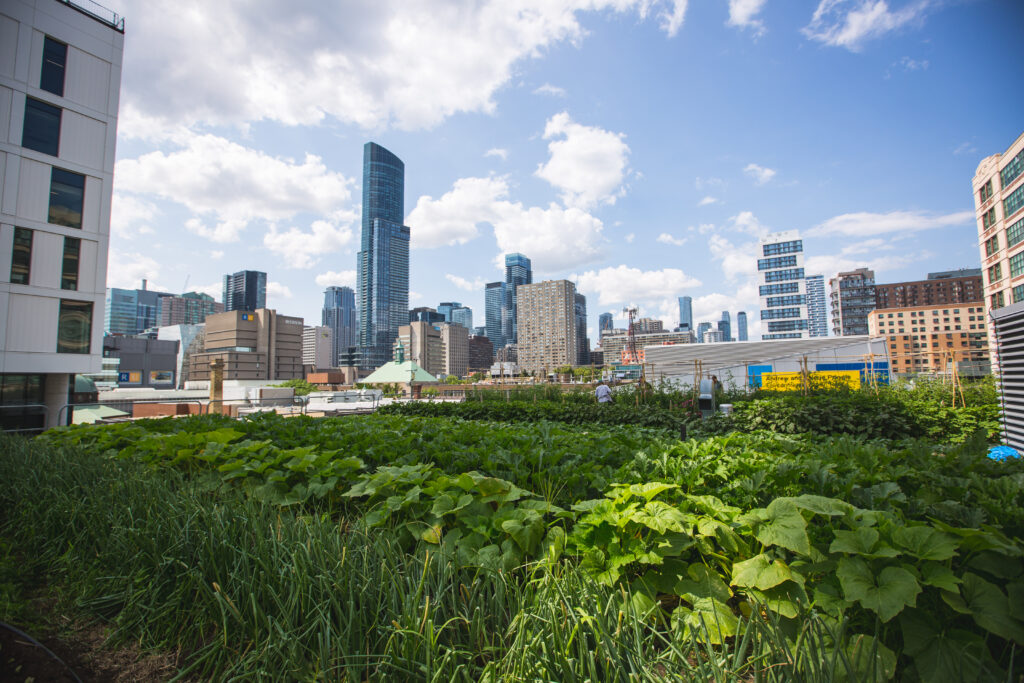
Jess Russell is the Operations Coordinator at the Toronto University (TMU) Urban Farm, a unique rooftop growing space found in city skies, where food growing meets research, education, and community connection. This is where we source some of the “extra” embellishments that end up on plates from the Moss Park Market! Items like garlic scapes, chili peppers, and flavour-popping cherry tomatoes, that reflect both the care of small-scale growing and the creativity of urban agriculture.
Jess has worked on the rooftop for eight years, helping to steward a space where students, volunteers, and partner growing teams come together to explore what a more connected and responsive food system can look like. The farm specializes in ecological growing practices, prioritizing soil health, biodiversity, and low-impact methods that work with the surrounding environment. At the same time, it serves as a living classroom, where research and hands-on learning intersect with urban challenges like climate resilience, food access, and urban land use.
Whether tending crops alongside students, working on her local flower farm , or sharing knowledge with the broader community, Jess’s role helps bridge the gap between urban structures and agricultural practice, reminding us that even in dense city environments, meaningful, nourishing food systems exist.
The Farm is home to many species, projects, and initiatives, while rooting itself in a deeper intention of shared space and relationships.The Harvest Collective & Learning Circle programs, as part of the Black Food Sovereignty Initiative, and the Indigenous Foodways Program are amongst these living connections. Together, these programs expand the role of the farm beyond growing food, creating space for cultural connection, education, and community stewardship.
When asked about food sovereignty, program leads Nicole Austin (Black-led Programs Coordinator) and Samantha Williams (Indigenous-led Programs Coordinator) shared their thoughts:
“The Urban Farm would describe food sovereignty as a deep connection between people and their right to access healthy and culturally appropriate food through ecological and sustainable farming practices. It’s prioritizing local growers, respecting nature and biodiversity. Food sovereignty is placing control over food systems in the hands of local food providers and builds knowledge by supporting traditional knowledge and, in some contexts, Indigenous knowledge sharing. We try to amplify this at the Urban Farm through our Black Food Sovereignty Initiative and our Indigenous Foodways Program.”
Samantha adds:
“Food sovereignty is reclaiming our cultural identities and reconnecting through revitalization of lost, forgotten, or stolen traditional agricultural practices that restore community connection. It’s reclaiming the knowledge of culturally significant food crops that have sustained us for generations and remembering our relationship to the land and our collective responsibility for stewardship.”
Interview
Can you tell me more about how the TMU rooftop started?
Jess – It started because a group of nutrition students were growing on the ground level on campus in underutilized spaces and there was already a green roof built on this new engineering building which [TMU] facilities had been taken care of for 10 years. It was just a green roof that grew lots of different wild plants and decomposing matter, making this beautiful soil. They really didn’t want to take care of it anymore and wanted an opportunity for these students to try growing on a green roof, which was kind of a new concept. So they did a test plot and everything grew beautifully because it had all those years of building this healthy soil. Then in the following year they converted the whole engineering rooftop into a rooftop farm. That’s how it got started.
Can you tell me more about the historical connection between Building Roots and TMU, and how the farm benefits from our partnership?
Jess – Yeah, so it’s interesting. The partnership and collaboration between the urban farm and Building Roots started during the pandemic because campus had closed. We already had some food crops growing on the roof.
We had planted fall crops [since] we wanted to grow nutritionally dense storage crops because there was food insecurity in the city at that time. But we didn’t have all of our [distribution] channels. We had to think outside the box and then I started looking. Before we were so focused on distributing the food just on campus and serving the TMU community. I started looking outside the parameters, but still close to TMU campus. And that’s when I discovered Building Roots. And I looked at all the programs that you were having, especially during that, like early 2020, and thought this is the perfect donation place to work with. Because it made us rethink our distribution model and how we donated.
It was a great partnership. Building Roots was able to take our food and make sure it was going to all their programming. And we wanted to support that. We changed the way we harvested the food. So instead of just giving unsold food from the farmers market, we had a harvest day dedicated to donating to Building Roots and other donation partners. It [We adopted] a Model of Thirds distribution system so that there’s equity between all the harvest days so a donation partner doesn’t get any less vegetables or less quality or it’s exactly the same as the vegetables that we’re bringing to market day harvest. The partnership with Building Roots just makes the most sense. Like, we’re growers. We really need to partner with someone that has systems in place, that has the outreach, that knows what they’re doing, and has a community. So I think that’s important for farms to partner with someone that they really respect and that is doing good work in the community.
What kinds of partnerships help the farm thrive?
Jess – We collaborate and partner with so many. Our stakeholders and our external community partnerships, and especially through our new food sovereignty initiatives. We collaborate with
the school of fashion on our natural dye plot. They’re one of our research partners. Our living lab research platform really is able to connect with lots of different types of academics, researchers, even artists. Green Roofs for Healthy Cities is a big partner for us. And then for the Indigenous Foodways [program], they are partnered with the indigenous student services on campus and have lots of programming within that [such as] their own meetup groups, [and] full moon ceremony. It’s a wide, wide range of people, community partners and internal partners that we collaborate with. Building Roots, of course, there’s lots more.
If people want to see the farm contribute or get involved, how would they go about it?
Jess – Following us on social media is the best way, @tmuurbanfarm – all the information is there for workshops, training programs, tours, free stuff, volunteering. It’s all on there or on our website. And anyone can come any Wednesday from June until October to the DCC building which is at 288 Church Street, 8th floor, from 11am till 2pm.
I wish more people would come and get involved with us because we have so much amazing programming. I think the number one thing is for people to come, visit us, and get involved.
We extend a sincere and gracious thank you to Jess, Nicole, Samantha, TMU, and all of the hands, critters, and efforts that go into shaping the interrelations between people, land, and food. Between our farmers and markets, and what keeps our food systems vital, local, and just.